
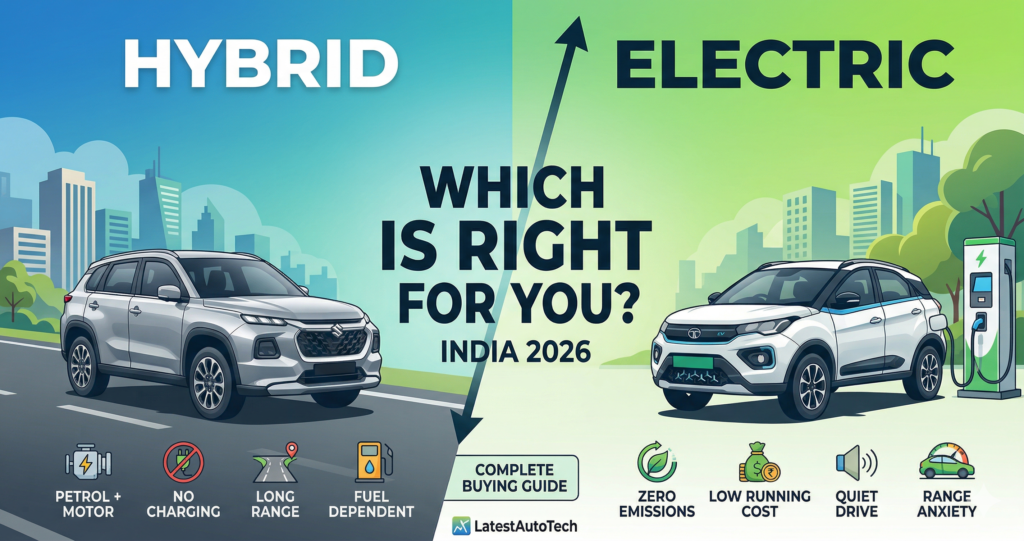

With rising fuel prices and increasing awareness about sustainability, more buyers are now considering hybrid and electric vehicles (EVs). But the big question remains: which one is right for you?
Both options offer fuel savings and lower emissions compared to traditional petrol or diesel cars. However, they differ significantly in terms of technology, cost, and usability. In this guide, we break down everything you need to know to make the right decision.
What is a Hybrid Car?
A hybrid car combines a petrol engine with an electric motor. It doesn’t need external charging because the battery charges itself through regenerative braking and the engine.
Types of Hybrid Cars:
- Mild Hybrid: Assists the engine but cannot run purely on electricity
- Strong Hybrid: Can run short distances on electric power alone
Pros of Hybrid Cars:
- Better fuel efficiency than petrol/diesel
- No need for charging infrastructure
- Smooth driving experience in city traffic
- Lower emissions compared to traditional cars
Cons of Hybrid Cars:
- Still dependent on fuel
- Higher cost than petrol cars
- Limited electric-only driving range
What is an Electric Car (EV)?
An electric vehicle (EV) runs entirely on electricity and uses a battery pack instead of an engine. It needs to be charged via home chargers or public charging stations.
Pros of Electric Cars:
- Zero tailpipe emissions
- Extremely low running cost
- Quiet and smooth driving
- Government subsidies and tax benefits
Cons of Electric Cars:
- The charging infrastructure is still developing in India
- Higher upfront cost
- Range anxiety on long trips
- Charging time can be long
Hybrid vs Electric: Key Differences
| Feature | Hybrid Cars | Electric Cars (EVs) |
| Fuel Type | Petrol + Electric | Fully Electric |
| Charging | No external charging needed | Requires charging |
| Running Cost | Moderate | Very low |
| Range | High (fuel + battery) | Limited (300–500 km typical) |
| Maintenance | Moderate | Low |
| Best For | Mixed usage | City & short commutes |
Cost Comparison in India
When comparing hybrid vs electric cars in India, cost plays a major role.
- Hybrid Cars: Slightly more expensive than petrol cars but cheaper than EVs
- Electric Cars: Higher initial price, but much lower running cost
Example:
- Petrol cost per km: ₹7–10
- Hybrid cost per km: ₹4–6
- EV cost per km: ₹1–2
In the long run, EVs can be more economical if you drive frequently.
Which is Better for City Driving?
If your usage is mostly within the city:
- Electric cars are the best choice due to low running costs and zero emissions
- Ideal for daily office commute and short trips
However, hybrids are also a good option if you don’t have access to charging.
Which is Better for Long Drives?
For highway driving and long-distance travel:
- Hybrid cars are more practical
- No need to worry about charging stations
- Better range and flexibility
EVs are improving, but infrastructure is still catching up in many parts of India.
Charging Infrastructure in India
India’s EV ecosystem is growing rapidly, especially in metro cities. However:
- Tier-2 and rural areas still lack sufficient charging stations
- Home charging setup is essential for EV buyers
If you live in an apartment without dedicated parking, EV ownership may be challenging.
Environmental Impact
- Electric Cars: Zero emissions while driving
- Hybrid Cars: Reduced emissions but not zero
EVs are clearly the better choice for environmentally conscious buyers.
Final Verdict: Hybrid vs Electric
Choosing between a hybrid and an electric car depends on your lifestyle:
Choose a Hybrid Car if:
- You frequently travel long distances
- You don’t have access to charging
- You want a balance between fuel efficiency and convenience
Choose an Electric Car if:
- You drive mostly in the city
- You have access to home or nearby charging
- You want the lowest running cost and the eco-friendly option
Conclusion
The debate between hybrid and electric cars ultimately comes down to your daily driving, budget, and access to charging infrastructure.
If you want a future-ready, eco-friendly solution and mostly drive in the city, EVs are the way forward. But if you need flexibility and worry-free long drives, hybrids still make a strong case.
As technology evolves, both options will continue to improve—making now a great time to switch to greener mobility.